

Introduction: Why Bonding Matters in Modern Industries
In every manufacturing process whether it’s building an aircraft, assembling a car or designing furniture secure bonding of materials is critical.
The wrong adhesive can lead to product failure, safety hazards and costly recalls. This is why solvent-based adhesives have been a trusted choice for decades.
Known for their high bonding strength, quick curing time and resistance to harsh conditions these adhesives often outperform alternatives.
Moreover thanks to recent innovations, they’re now eco-friendlier and safer to use making them ideal for modern industrial needs.
At Pak Gravure, we understand how challenging it can be to choose the right adhesive. This guide will help you explore what solvent-based adhesives are,
their advantages, real-world uses, and how they’re evolving to meet environmental standards.
What Are Solvent Based Adhesives?
Solvent-based adhesives are liquid bonding agents that use chemical solvents to dissolve polymers. Once applied, the solvent evaporates,
leaving behind a solid adhesive layer that forms a strong and lasting bond between surfaces.
Unlike water-based adhesives, which evaporate more slowly, solvent-based formulations bond faster and are better suited for non-porous materials like plastics and metals.
Key Characteristics:
– Fast Drying: Ideal for high-speed assembly lines
– High Strength: Instant grip with long-lasting durability
– Versatile: Bonds both similar and dissimilar materials
– Heat & Chemical Resistant: Performs well in extreme conditions
Performance Benefits That Set Solvent-Based Adhesives Apart
- Rapid Strength Development
Solvent-based adhesives are excellent for fast-paced manufacturing. They quickly develop green strength, allowing bonded parts to be processed almost immediately.
Example: In automotive assembly, bonded panels move to the next stage within minutes—without risking detachment.
- Multi-Material Bonding
These adhesives can bond metals, plastics, textiles, wood and more materials that others often struggle with.
Example: Footwear manufacturers use them to bond rubber soles to leather uppers, where both flexibility and strength are vital.
- Resistance to Harsh Conditions
Solvent-based adhesives withstand high heat, humidity and chemical exposure making them ideal for marine, outdoor and industrial applications.
- Cost-Effective and Efficient
With high solids content, you use less adhesive per job. This lowers material costs and also reduces your carbon footprint.
- Safer Modern Formulations
Newer variants are non-flammable, emit low VOCs and comply with global safety standards a big win for health and the environment.
Industries That Rely on Solvent Based Adhesives
– Aerospace: Bonding lightweight panels and insulation for extreme durability
– Automotive: Used in dashboards and panels for impact resistance
– Electronics & Appliances: Suitable for heat-sensitive components
– Marine & Sports Equipment: Waterproof bonding for boats and surfboards
– Footwear & Assembly: Rubber-to-leather bonding with long-lasting flexibility
– Woodworking & Furniture: For laminates, panel bonding and upholstery
– Textiles & Packaging: Common in carpet laying and multilayer films
Types of Solvent Based Adhesives and Their Applications
- Styrene-Butadiene Copolymer (SBC)
Best For: Foam, textiles
Key Strengths: Flexible and lightweight bonding
Industry Use: Mattress and upholstered furniture manufacturing
- Polychloroprene (CR) – Contact Adhesives
Best For: Rubber, leather, metal
Key Strengths: Instant grip, heat resistance
Industry Use: Shoe manufacturing
- Polyurethane (PU)
Best For: Flexible PVC and plastics
Key Strengths: Plasticizer resistance, long-term durability
Industry Use: Upholstered furniture requiring flexibility
- Specialty Adhesives
– Acrylic: Weather-resistant, used in outdoor applications
– Rubber-Based: Flexible and impact-resistant for heavy machinery
– Epoxy: Chemical-resistant and extremely durable, perfect for aerospace
Advanced Eco-Friendly Formulations
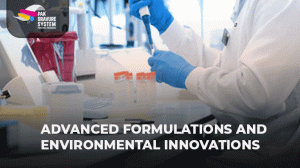
Due to increasing environmental concerns, modern adhesives are now both effective and sustainable. Here’s how:
– High solids: Less solvent needed, fewer emissions
– Low VOCs: Better indoor air quality
– Non-flammable: Improved safety
– Globally compliant: Meets worldwide regulations
These changes ensure that industries can bond strongly while protecting the planet.
Application Methods for Best Results
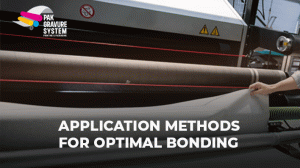
To get the strongest bond, the application method matters as much as the adhesive itself:
– Brush or Roller: Ideal for small surfaces and manual work
– Spray Application: Perfect for large surface coverage
– Bead or Ribbon: Accurate and reduces waste
Pro Tip: Always clean and dry surfaces before applying adhesives. Allow full curing time for optimal strength.
FAQs – Everything You Need to Know
- Are solvent-based adhesives waterproof? Yes. Ideal for marine and outdoor use.
- Can they bond plastic surfaces? Absolutely with proper surface prep.
- How do I remove adhesive residue? Use solvents like acetone or isopropyl alcohol.
- Are they heat-resistant? Yes. They handle high temperatures well.
- Do they expire? Yes, usually within 6–24 months depending on storage.
- Are they safe for indoor use? Modern versions are low in VOCs safe with good ventilation.
- Are eco-friendly versions weaker? No. Today’s eco-friendly adhesives match traditional performance.
Why Choose Pak Gravure for Your Adhesive Needs?
Choosing the right adhesive is critical for long-term performance. At Pak Gravure we offer:
– Certified food safe and industrial adhesives
– Customized solutions for packaging and printing
– Expert technical support
Speak to Our Specialists → +92 314 2985341
Visit: PakGravure.com