
Executive Summary
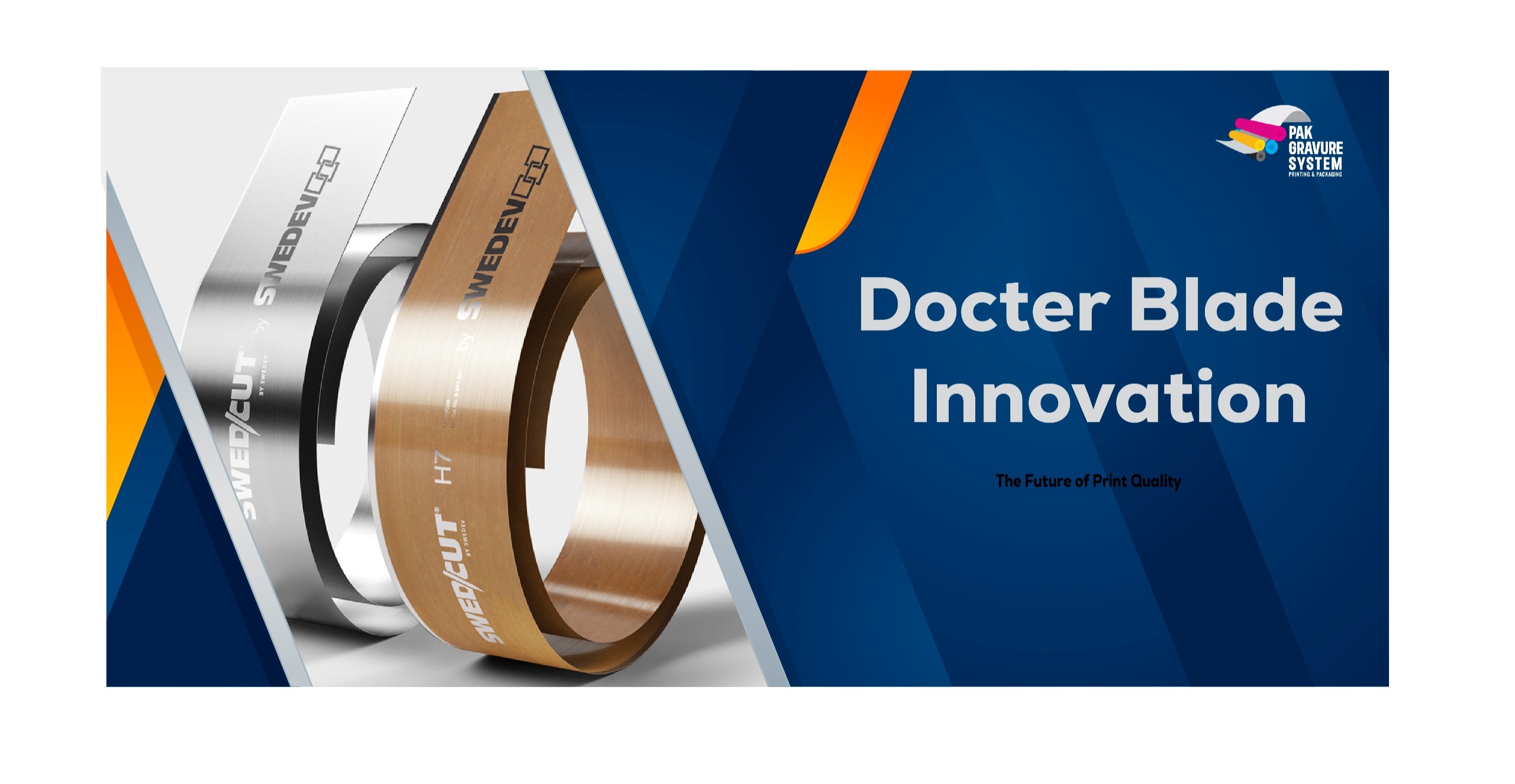
In today’s highly competitive printing landscape, the smallest components often deliver the greatest competitive advantage. The doctor blade — a precision metering tool at the heart of every gravure and flexographic press — is undergoing a technological renaissance. This article explores how advanced blade coatings, smarter materials, and system-level integration are transforming print quality, reducing operational costs, and driving sustainability across the industry.
The Evolving Standard of Precision Printing
Press operators are familiar with the phrase: “We’ve always done it this way.” It’s a sentiment rooted in reliability — but in an era where margins are tight and quality expectations are absolute, familiarity without optimization is a competitive liability.
Modern flexographic and gravure printing systems operate at extraordinary speeds, handling substrates that demand flawless ink transfer with every revolution. At the center of this precision sits the doctor blade — a deceptively simple component whose performance defines everything from color accuracy and print sharpness to long-run consistency and waste reduction.
Whether your operation relies on chambered doctor blade systems, manual flexo setups, or high-speed rotogravure presses, the fundamental principle remains unchanged: precise ink metering is non-negotiable for flawless output.
What a Doctor Blade Actually Does
A doctor blade performs one critical function: it meters the ink. Applied at a controlled angle and pressure against the anilox roller or rotogravure cylinder, it wipes away excess ink while leaving a precise, uniform film ready for transfer to the substrate.
When this function is compromised — through blade wear, incorrect angle, or material mismatch — the consequences appear immediately on press:
Over-inking and ink spitting: excess ink bypasses the blade, saturating the substrate and causing smearing.
Ghosting and streaking: inconsistent film thickness creates visible density variations across the web.
Missing print areas: blade deflection leaves ink-starved zones in high-speed runs.
Cylinder damage: blade wear particles score the anilox surface, compounding defects over time.
The Case for Coated Doctor Blades
Every print professional understands that blade selection directly impacts press performance. Coated doctor blades represent a meaningful leap beyond standard steel or uncoated polymer alternatives.
Reduced Friction: Specialized coatings create ultra-smooth contact surfaces, reducing heat and wear on both the blade and the cylinder.
Extended Blade Life: Lower friction and superior wear resistance translate directly into fewer blade changes and reduced press downtime.
Corrosion Resistance: Coated blades maintain structural integrity in humid or chemically aggressive ink environments, ensuring consistent performance over long production runs.
Ink Spitting Prevention: Uniform surface geometry eliminates micro-gaps that allow ink droplets to bypass the metering edge.
Sustainability Gains: Longer service life means less material waste, fewer replacement cycles, and a lower total environmental footprint per job.
Why Blade Coating Is a Strategic Investment
The most common objection from procurement teams is straightforward: “Is the premium worth it?” The answer, supported by operational data from presses worldwide, is an unequivocal yes.
The right coating profile enhances three critical blade properties simultaneously:
Hardness: Maintains metering edge geometry under sustained pressure, delivering consistent ink film thickness across the entire web width.
Flexibility: Allows the blade to conform to cylinder surface irregularities without fracturing, protecting both the blade and the anilox.
Wear Resistance: Dramatically extends service intervals in high-speed production environments, reducing the frequency and cost of blade change-overs.
Across rotogravure, flexo, and doctor blade machine applications, coated blades also prevent adhesive build-up on the metering edge — a significant driver of unplanned press stops. The cumulative effect is cleaner output, longer maintenance intervals, and a measurable improvement in cost-per-thousand impressions
Doctor Blade Coating in Industrial Applications
Beyond conventional printing, the doctor blade coating technique plays a vital role in textile finishing and specialty substrate processing. In these applications, liquid coatings are applied and precisely metered across a moving substrate to achieve controlled layer thickness , a process where blade angle, gap geometry, and material properties must work in concert.
At Pak Gravure, our coating systems are engineered to maintain this precision at production scale. The relationship between blade material, coating composition, and substrate tension determines the final coating weight and uniformity , variables that define product quality in everything from flexible packaging films to coated technical textiles.
Frequently Asked Questions
What is a doctor blade? A doctor blade , also called a metering blade , is a precision component used in gravure and flexographic printing to control the volume of ink transferred from the cylinder or anilox roller to the substrate.
Why are they called “doctor” blades? The term derives from the Latin doctare, meaning “to wipe” or “to clean.” It reflects the blade’s primary function: removing excess ink from the cylinder surface to leave only the metered amount required for print.
What doctor blade angle is used in gravure printing? The standard operating angle in gravure printing ranges from 55° to 65°. This range balances efficient ink removal with controlled wear, preserving both blade and cylinder life.
What is a chamber doctor system? A chambered doctor blade system is an enclosed inking assembly that uses two doctor blades , one to meter ink, one to contain it ,creating a sealed chamber that minimizes evaporation, contamination, and ink waste while improving consistency.
What types of doctor blades are available? The three primary categories are steel blades (high durability for demanding applications), polymer blades (cylinder-friendly for sensitive anilox surfaces), and coated blades (optimized for extended life, reduced friction, and maximum print consistency).
Who manufactures doctor blades? Pak Gravure Systems designs and supplies precision doctor blades for gravure and flexographic presses. Global suppliers also serve specific regional and application requirements across the packaging, label, and publication printing segments.
Looking Ahead: The Future of Doctor Blade Technology
As printing technology continues its rapid evolution, the doctor blade is evolving with it. Advances in nano-composite coatings, adaptive blade geometries, and integrated monitoring systems are enabling a new generation of presses that are sharper, faster, and more sustainable than any previous standard.
For operations committed to print excellence, the question is no longer whether to invest in advanced doctor blade solutions — it is how quickly that investment can be implemented to capture the performance and cost advantages that modern blade technology delivers.
Ready to optimize your press performance? Explore Pak Gravure’s full range of precision doctor blade solutions — engineered to keep your presses running sharper, faster, and more sustainably.
www.pakgravure.com
© 2025 Pak Gravure Systems. All rights reserved. | Print Technology Series