
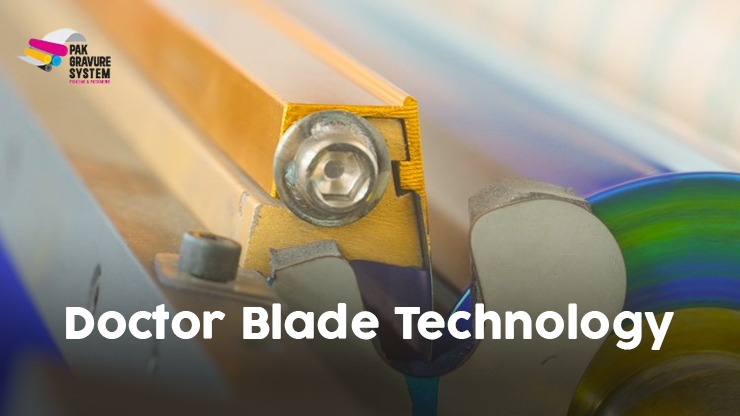
The printing industry has transformed drastically in recent years, driven by the demand for speed, sustainability and uncompromised print quality. Whether in flexographic or gravure printing processes the invisible hero ensuring consistent, sharp and flawless output is the doctor blade. This slender yet powerful tool has become the backbone of precision printing, particularly in packaging where quality cannot be compromised.
In this blog we will dive deep into what a doctor blade is, why it matters, the materials and configurations available, innovations shaping its role and how it supports sustainable and hybrid printing technologies.
What Is a Doctor Blade in Printing?
At its core a doctor blade in printing is a thin sharp-edged strip commonly made of steel, carbon or plastic designed to meter ink on the printing cylinder. Its primary job is to scrape excess ink from the anilox roller in flexo printing or the gravure cylinder in rotogravure printing.
This ensures that only a consistent and uniform ink layer transfers onto the substrate, producing clean images, fine lines and sharp gradients. Without a doctor blade, over-inking, streaks, ghosting and blurred prints become unavoidable.
Many printers refer to this component interchangeably as a printing doctor blade, dr blade, doctoring blade or ink metering blade. Regardless of the name the purpose remains the same: precise ink control that defines print quality.
The Role of Doctor Blades in Flexographic and Gravure Printing
Both flexo doctor blades and doctor blades for gravure printing process play an essential role in ink metering.
- In flexo printing: doctor blades regulate the ink film on the anilox roller. This guarantees sharp labels, vibrant flexible packaging and high-quality tapes.
- In rotogravure printing: they wipe excess ink off the engraved cells of the rotogravure cylinder engraving machine: leaving only the desired volume to transfer onto the substrate.
When printers neglect doctor blade setup, issues like dot gain, railroading and ink spitting often surface. That is why the doctor blade flexo printing systems and doctor blade in gravure printing process must be carefully aligned and monitored for efficiency.
What Is the Doctor Blade Angle in Gravure Printing?
The doctor blade angle is one of the most crucial factors in rotogravure printing. Typically set between 55° to 65° the angle determines how effectively the blade scrapes ink.
- Too shallow an angle can leave excessive ink on the cylinder.
- Too steep an angle increases wear on both the doctor blades and the cylinder surface.
Optimizing this angle helps printers achieve sharper dots, longer blade life and smoother gradients. For consistent packaging print quality, understanding “What is the doctor blade angle in gravure printing?” is non-negotiable.
Materials Used in Manufacturing Printing Doctor Blades
The performance of a doctor blade in printing depends largely on the material used. Today, manufacturers offer several choices:
-
Carbon Steel Blades
- Budget-friendly
- High wear resistance
- Common for general-purpose applications
-
Stainless Steel Blades
- Excellent corrosion resistance
- Preferred in high-speed presses
- Longer life span
-
Plastic/Polymer Blades
- Used with worn rollers
- Reduce abrasion on delicate surfaces
- Safer handling for operators
-
Composite Blades
- Combine steel durability with polymer flexibility
- Increasingly popular in hybrid setups
Each option balances cost, durability and performance. In most high-speed flexo doctor blades and dr. blades for gravure, steel remains the industry standard.
Doctor Blade Edge Profiles and Configurations
Doctor blades are not all the same. Their edge profile determines ink shearing performance. Common configurations include:
- Straight Edge: Standard square edge, economical for non-critical jobs.
- Beveled Edge: Cut at an angle offering durability at moderate speeds.
- Lamella Edge: Ultra-thin tip with high flexibility, ensuring precise ink metering in modern chamber systems.
Among these, the lamella profile is the most widely adopted in chamber doctor blade systems due to its ability to deliver crisp, high-resolution prints at high speeds.
Doctor Blade Coatings: Extending Life and Efficiency
Modern printing doctor blades often feature advanced coatings that boost durability and performance. The most common include:
- Ceramic Coatings – Improve wear resistance and extend blade life.
- Anti-Friction Coatings – Reduce heat buildup and cylinder wear.
- Corrosion-Resistant Coatings – Essential when using water-based inks.
By minimizing downtime and ensuring consistent print runs, coated doctor blades for flexo printing deliver excellent return on investment for packaging converters.
Chamber Doctor Blade Systems: Redefining Ink Control
While older presses relied on open systems, modern machines increasingly adopt chamber doctor systems. These enclosures use dual blades to both meter and contain ink.
Benefits include:
- Reduced evaporation and contamination
- Consistent ink density
- Safer blade handling and faster changeouts
Doctor chamber systems also reduce operator fatigue, improve workplace safety and help maintain print quality during long production runs.
Doctor Blade Technology and Sustainable Printing
Sustainability is now a driving force in packaging. As industries shift toward water-based inks and PU inks, the demand for efficient ink metering grows.
Doctor blades in printing :contribute to sustainability by:
- Reducing ink wastage through precise metering
- Minimizing defective prints and re-runs
- Supporting longer press uptime with durable materials
In a country like Pakistan, where packaging demand is surging, adopting eco-friendly doctor blades is vital for staying competitive.
Technological Innovations in Doctor Blades
The evolution of doctor blade flexo printing systems reflects broader advances in the industry. Recent innovations include:
- Smart Blade Holders: With automatic oscillation to reduce edge wear.
- Predictive Maintenance Systems: Replacing blades before failures occur.
- Hybrid Machines: Combining flexographic and digital printing, requiring versatile dr. blades.
- Advanced Alloys and Composites: Offering four times greater resistance than traditional blades.These developments allow printers to scale operations efficiently while reducing downtime.
Common Problems with Doctor Blades and Their Fixes
Even the best doctor blades can fail if not properly managed. Typical issues include:
- Railroading – Ink lines at edges due to misalignment
- Ink Spitting – Caused by blade angle issues
- Dot Gain – From excessive pressure or dull blades
- Cylinder Wear – Often due to using incorrect blade material
By maintaining correct doctor blade angle in gravure printing and regular monitoring, most problems can be avoided.
Doctor Blade Beyond Printing: Coating Applications
Interestingly, doctor blades extend beyond packaging printing. They are widely used in:
- Functional Film Coating – For batteries and barrier films
- Medical Diagnostics – Precision strips and sensors
- Solar Films – Including perovskite and OPV layers
- Flexible Electronics – Where micron-level precision is critical
These industries demand the same durability and consistency that printing doctor blades offer in packaging.
Doctor Blade Market in Pakistan
For Pakistan’s growing packaging industry, doctor blades represent a crucial investment. With more converters moving toward rotogravure and flexo printing, the need for reliable, durable and cost-efficient doctor blades for flexo printing is at an all-time high.
- Local manufacturers offer budget-friendly dr. blades.
- Imported high-end options deliver longer life for high-speed presses.
- Companies adopting chamber doctor systems are gaining an edge in efficiency and print quality.
The Future of Doctor Blade Technology
The future points toward automation, sustainability and hybrid solutions. Faster and wider presses demand flexo doctor blades and doctor blades in gravure printing processes that can endure heavy loads without compromising print sharpness.
With AI-driven predictive maintenance and smarter materials, doctoring blade technology is set to revolutionize both packaging and specialty printing in the coming decade.
Why Choosing the Right Doctor Blade Matters
From flexo doctor blades to dr. blades in gravure, the importance of this component cannot be overstated. It is the final checkpoint between ink and substrate, determining whether packaging prints look premium or substandard.
For Pakistani converters, investing in high-quality printing doctor blades ensures:
If you are looking to upgrade your doctor blade systems or explore advanced doctor chamber technologies, now is the time. Choose reliable doctor blades for flexo printing and gravure processes to stay ahead in the competitive packaging market.
FAQ,S
What is a doctor blade called?
A doctor blade is also called a printing blade used to remove excess ink from a printing cylinder.
Why are they called doctor blades?
They are called doctor blades because they “doctor” or wipe ink cleanly off the cylinder surface.
Who makes doctor blades?
Doctor blades are made by specialized printing equipment manufacturers and suppliers worldwide.
What is the blade used by doctors?
The blade used by doctors is a surgical scalpel, not related to printing doctor blades.