
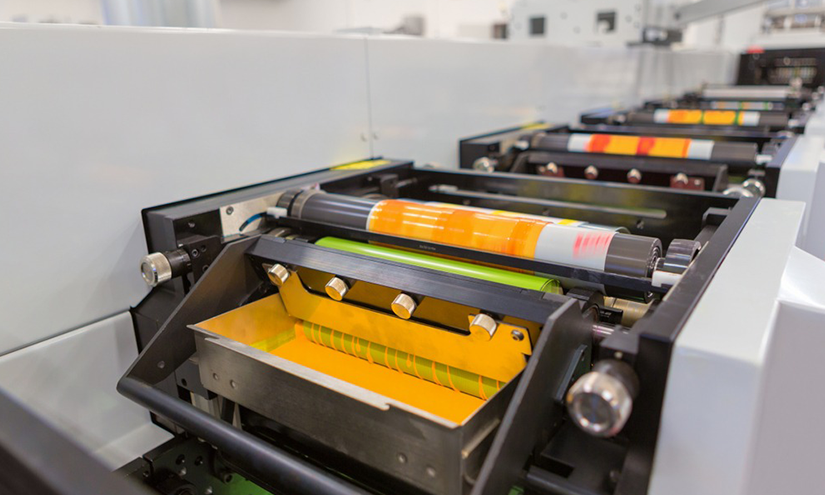
Most printing operations in Pakistan are losing money on doctor blades without realizing it. The blade itself is not expensive. But the wrong blade costs far more in downtime, reprints, and cylinder damage. At Pak Gravure, we have spent the last decade supplying printing doctor blades to gravure and flexo operations across Pakistan. The same two problems come up every time: blades that wear out too fast, and blades that were never right for the press.
What a Printing Doctor Blade Actually Does — and Why It Matters More Than Most Realize
The doctor blade is the only thing standing between a clean print and an ink flood. Its job is to press against the cylinder, wipe off excess ink, and leave only what sits inside the engraved cells. But that contact point is where most print quality problems begin. Blade too soft — it wears before the shift ends. Blade too hard — it scores the cylinder. Wrong edge profile — you get streaking no matter how well the press is set up.
A doctor blade has three variables that determine whether it works or causes problems: material, edge geometry, and thickness. Material controls how the blade holds up under friction and ink chemistry. Edge geometry controls how cleanly it wipes at speed. Thickness determines how much pressure the blade applies under load. Get all three right and the blade runs a full shift without issue. Get one wrong and you are changing blades mid-run, chasing streaks, or sending a cylinder out for re-engraving.
Gravure Printing Doctor Blades — Specified for High-Speed Cylinder Contact
Gravure is an unforgiving process when it comes to doctor blade performance. The cylinder runs fully flooded with ink at speeds exceeding 300 meters per minute. The blade is the only control point for what gets wiped and what gets printed. Any inconsistency in hardness, edge sharpness, or dimensional tolerance shows up immediately — as a streak, a band, or tonal variation across the web.
The gravure doctor blades Pak Gravure supplies are sourced from manufacturers who produce to tight metallurgical and dimensional specifications. Hardness is controlled to match cylinder chrome hardness. Edge geometry is consistent across the full blade length. Thickness tolerance is held within microns. For flexible packaging, decorative laminates, and publication printing — where color consistency across long runs matters — these tolerances are not optional. They are what separates a blade that completes a job from one that gets changed three times before it is done.
Flexo Printing Doctor Blades — Chamber Blade Systems and Anilox Metering
In flexo printing, the doctor blade controls what goes into the anilox — which controls everything that follows. A chamber blade running a worn or mismatched blade does not just meter ink poorly. It meters inconsistently. That means color variation across the web and density shifts mid-run. It often does not look like a blade problem. It looks like an ink problem or a setup issue — until someone checks the blade edge and finds it has rounded off or chipped.
Pak Gravure supplies flexo doctor blades in carbon steel, stainless steel, and polymer — matched to the anilox specification and ink system in use. For high line-count anilox rolls, blade selection is critical. Too aggressive and it damages the ceramic coating. Too soft and it will not wipe cleanly. For food-grade and pharmaceutical packaging, we supply polymer blades where metal contamination is a compliance requirement. Every blade is checked for edge consistency before leaving our stock.
How to Know If You Are Using the Wrong Printing Doctor Blade
If your press team is changing doctor blades more than once per shift, the specification is wrong — not just the blade. Frequent blade changes are the most common complaint we hear from new clients. In most cases the cause is a mismatch between blade hardness and cylinder hardness, or a thickness that puts too much pressure on the contact zone. Running harder blades to solve a wear problem often makes it worse. A harder blade that is not matched to the cylinder coating will score the surface before it visibly wears out.
Four things must match before a blade performs correctly: material grade, thickness, edge type, and contact angle. At Pak Gravure, before recommending a blade, we ask about the cylinder type, ink system, press speed, and what the current blade is doing wrong. That conversation takes ten minutes. It usually prevents weeks of trial and error. If your current blade came from a cheap supplier with no technical input, the specification is probably a guess — and guesses cost production time.
Why Printing Operations Across Pakistan Work with Pak Gravure
Pak Gravure has been supplying printing doctor blades in Pakistan for close to a decade. We do not stock blades from every supplier who offers a low price. We source from manufacturers whose processes we know, whose quality documentation we have reviewed, and whose blades we have tested under real press conditions. A blade that fails mid-run does not just cost the price of the blade. It costs the downtime, the waste, and sometimes the cylinder.
We maintain local inventory so operations are not waiting weeks for an import shipment. We supply gravure doctor blades, flexo doctor blades, chamber blade assemblies, and blade cartridges for all major press configurations in Pakistan. Our clients range from large flexible packaging converters to mid-size label printers. Technical support does not stop at the point of sale. If a blade is not performing, we find out why. That is what ten years in this industry looks like.